
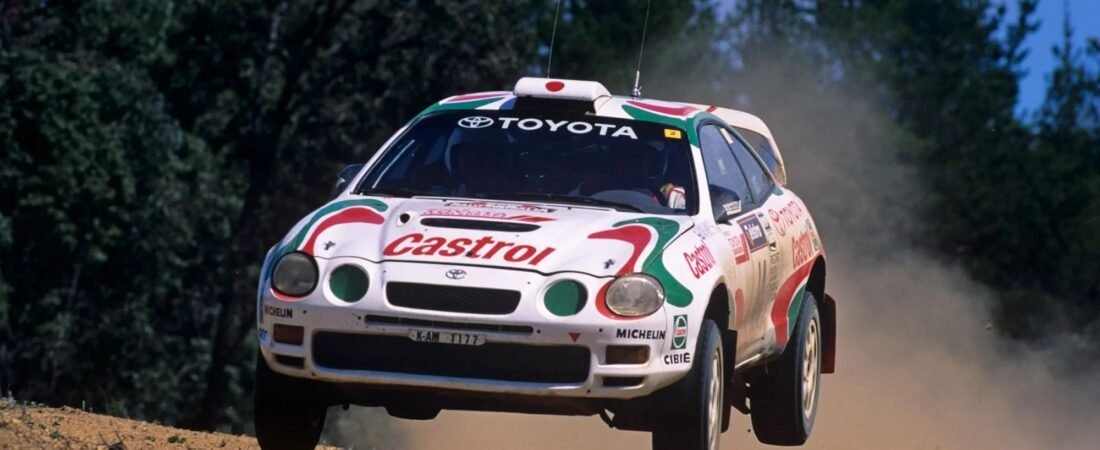
Toyota was caught cheating in the World Rally Championship in 1995. There was no gray area, no clever interpretation of an ambiguous regulation and no technical loophole that lawyers could argue about afterward.
The system hidden inside the Toyota Celica GT-Four was illegal.
But there was one problem for the FIA: it was brilliant.
The device was so cleverly engineered that FIA president Max Mosley famously described it as the most sophisticated and ingenious system he had encountered in decades of motorsport.
And perhaps the most remarkable part of the Toyota WRC cheating scandal was not that the device gave the Celica more power. It was that simply taking it apart for inspection helped hide the evidence.
Why Toyota Needed to Beat the 34mm Turbo Restrictor
By the mid-1990s, World Rally Championship cars had become extraordinarily sophisticated turbocharged, four-wheel-drive machines.
The FIA was increasingly concerned about controlling performance, and one of its most important weapons was the turbo air restrictor.
For 1995, Group A rally cars were required to use a 34mm intake restrictor. The idea was simple: limit the amount of air entering the turbocharger and you limit how much power the engine can produce.
It was essentially a bottleneck.
Teams could improve engines, turbochargers, electronics and countless other components, but all the air still had to pass through that restricted opening.
Toyota Team Europe had another idea.
Instead of making air pass through the restrictor, its engineers created a way for some of the air to go around it.
The modification was hidden inside the intake assembly of the Toyota Celica GT-Four ST205. From the outside, the restrictor itself appeared to comply with the required 34mm diameter.
Once installed, however, the situation changed.
A sophisticated mechanism allowed the restrictor to move approximately 5mm away from its normal position, opening a secondary path around it. Air could then enter the turbo without passing through the legally mandated opening.
That tiny five-millimeter movement made an enormous difference.
Contemporary and later accounts generally estimate that the system increased airflow by roughly 25% and could provide around 50 additional horsepower.
In motorsport, where engineers fight for tiny performance gains, 50 horsepower was enormous.
But extra power wasn’t the most impressive part.
The real masterpiece was hiding it.
The Illegal Turbo Restrictor That Hid Itself
Normally, finding an illegal component should become easier once officials dismantle the car.
Toyota’s system effectively did the opposite.
The restrictor was concealed beneath the hose connecting the air intake to the turbocharger and held in place with clamps. When assembled in its competition configuration, the mechanism could move the restrictor and create the illegal gap.
But when FIA inspectors removed the assembly, releasing the clamps also released the mechanism.
The restrictor returned to its normal position.
In other words, the act of dismantling the system for inspection helped make it appear legal again.
There were no crude holes drilled into the intake and no obvious external bypass pipe. The mechanism was integrated into a component that appeared normal until investigators knew exactly what they were looking for.
Mosley later praised the workmanship itself, noting how carefully the internal components had been manufactured.
Toyota had effectively created a device with two personalities: one configuration for competition and another that appeared when inspectors took it apart.
And for much of 1995, it worked.
Rival Teams Knew Something Was Wrong
Toyota entered the 1995 season as one of rallying’s dominant forces.
Juha Kankkunen had won the drivers’ championship with Toyota in 1993, while Didier Auriol followed with another title in 1994. Toyota also won the manufacturers’ championship in both seasons.
So a fast Celica was hardly suspicious by itself.
But eventually, competitors began noticing just how fast it was.
One particularly revealing moment reportedly came during the 1995 Rally Australia.
Tommi Mäkinen, driving a Mitsubishi Lancer Evolution III, later recalled lining up alongside Juha Kankkunen’s Toyota during a head-to-head stage. When they accelerated, the Celica simply pulled away.
Mäkinen remembered wondering what had happened because the difference was so striking.
By the next WRC round, the Rally Catalunya in Spain, Toyota was under serious scrutiny.
FIA officials impounded turbochargers removed from the Celicas of Kankkunen and Auriol. During the subsequent examination, inspectors discovered that the airflow restrictors could move.
That shouldn’t have been possible.
Once investigators realized the restrictor could change position, the entire mechanism began to reveal itself.
Toyota’s secret was over.
The FIA’s Punishment Was Brutal
Didier Auriol initially finished the 1995 Rally Catalunya in his Toyota but was later excluded because of the illegal turbo restrictor. Kankkunen and Armin Schwarz had already retired from the rally.
Then the consequences became much larger.
On November 3, 1995, the FIA World Motor Sport Council excluded Toyota Team Europe from the 1995 World Rally Championship results and imposed a 12-month suspension.
Toyota’s drivers — Auriol, Kankkunen and Schwarz — also lost their championship points.
Importantly, the FIA did not accuse the drivers of designing or knowingly participating in the scheme. Mosley publicly said there was no suggestion that they knew what was happening.
The scandal dramatically reshaped the championship. Subaru ultimately won the 1995 manufacturers’ title, while Colin McRae defeated teammate Carlos Sainz for the drivers’ championship.
Toyota, meanwhile, disappeared from the WRC for 1996.
Why Toyota’s 1995 WRC Cheat Is Still Famous
Motorsport history is filled with teams pushing regulations until they nearly break.
This case was different.
Toyota’s system wasn’t famous because engineers discovered an overlooked sentence in the regulations. It became legendary because the mechanism was deliberately designed to circumvent a clear restriction — and then engineered to conceal what it was doing.
That is also what made the FIA’s reaction so memorable.
The governing body handed Toyota one of the harshest punishments in rally history while simultaneously acknowledging the extraordinary engineering behind the offense.
Three decades later, the 1995 Toyota WRC turbo restrictor scandal remains one of motorsport’s greatest technical stories.
Toyota lost its championship points, missed an entire WRC season and suffered an enormous public embarrassment.
But its engineers also created something almost unheard of in racing:
A cheat so ingenious that the people responsible for catching it couldn’t help admiring how it worked.
SEO Information
SEO Title: Toyota’s 1995 WRC Cheat Was So Ingenious Even the FIA Was Impressed
Meta Description: In 1995, Toyota hid an illegal turbo restrictor system inside its WRC Celica. Discover how the brilliant cheat worked, how the FIA found it, and why it led to a 12-month ban.
URL Slug: toyota-wrc-cheating-scandal-1995
Primary Keyword: Toyota WRC cheating scandal
Secondary Keywords: Toyota WRC cheat, Toyota turbo restrictor, Toyota Celica GT-Four WRC, 1995 WRC scandal, Toyota banned from WRC, Toyota Celica ST205, Toyota Team Europe, 1995 Rally Catalunya, WRC cheating scandal, Toyota illegal turbo
Alternative Titles
SEO: Toyota WRC Cheating Scandal: How the Illegal 1995 Turbo Restrictor Worked
Clickbait: Toyota Built a Cheat That Hid Itself — And Even the FIA Was Impressed
SEO + Clickbait: Toyota’s 1995 WRC Cheat: The Genius Illegal Device That Fooled the FIA
Sources
Motor Sport Magazine — historical reporting and retrospective accounts of Toyota’s restrictor system, its discovery and the 1995 WRC scandal.
Le Monde — November 5, 1995 contemporary report covering Toyota’s FIA punishment and the estimated 25% increase in airflow.
El País — November 4, 1995 contemporary reporting on Toyota Team Europe’s one-year suspension and removal of its 1995 championship points.
Road & Track — technical retrospective explaining the 5mm restrictor movement, hidden spring mechanism and estimated 50-horsepower advantage.
JUWRA — historical Rally Catalunya results confirming Didier Auriol’s exclusion for the illegal turbo restrictor.