
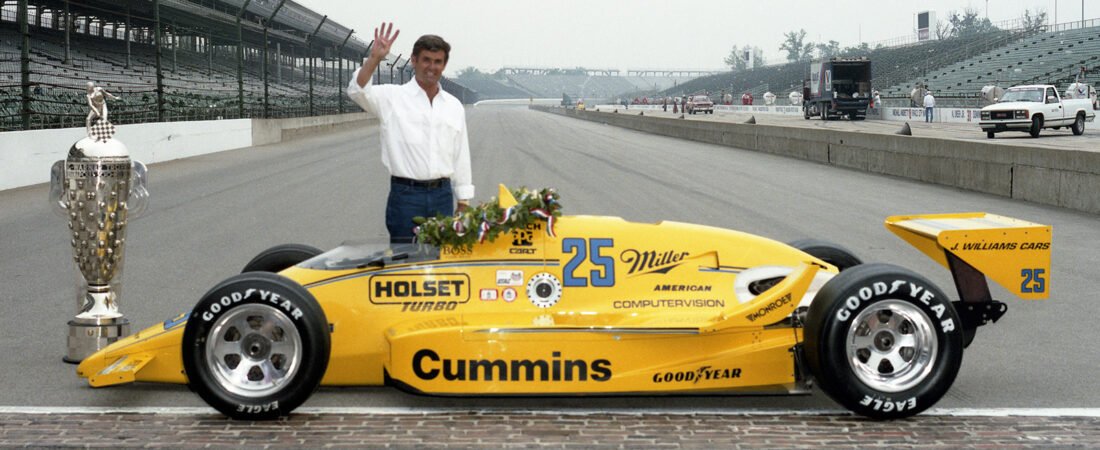
Weeks before the 1987 Indianapolis 500, the car that would eventually win the race wasn’t being prepared inside a garage at Indianapolis Motor Speedway.
It was sitting in a hotel lobby in Pennsylvania.
The March 86C had essentially become a show car, retired from frontline competition and put on display near Team Penske’s headquarters in Reading. Yet before the month of May was over, that same machine would be hurriedly returned to racing condition, driven from 20th on the grid and taken to Victory Lane by 47-year-old Al Unser.
It sounds almost impossible by modern racing standards. But the story of Al Unser’s 1987 Indy 500 victory is even stranger than the hotel-lobby legend suggests.
Al Unser Didn’t Even Have a Ride for the 1987 Indy 500
Unser entered May 1987 as one of the most accomplished drivers in Indianapolis history. He had already won the Indy 500 three times — in 1970, 1971 and 1978 — and had won the CART championship as recently as 1985.
But he didn’t have a car for Indianapolis.
Team Penske had moved forward with a lineup featuring Rick Mears, Danny Sullivan and Danny Ongais. Unser, no longer competing full-time, was at Indianapolis partly because his son, Al Unser Jr., was trying to qualify for the race.
Then everything changed.
Ongais suffered a violent crash during practice in Turn 4 and sustained a concussion. Indianapolis Motor Speedway’s medical director ultimately ruled him out for the remainder of the month.
Roger Penske suddenly needed another driver.
Unser was already there.
There was just one problem: Penske needed another competitive car.
Penske’s New PC-16 Had Become a Problem
Team Penske had arrived at Indianapolis with enormous expectations for its new PC-16 chassis. Instead, the car struggled.
The situation became serious enough that Penske began returning to the previous year’s March 86C, a proven design that had already enjoyed enormous success in IndyCar racing.
And the 86C had an interesting connection to a name that Formula 1 fans know extremely well: Adrian Newey.
Newey was one of the key designers behind the March 86C. The car had been spectacularly successful in 1986, winning 14 of the 17 CART races that season. Bobby Rahal had also used a March 86C to win both the CART championship and the 1986 Indianapolis 500.
So Penske wasn’t resurrecting a fundamentally bad car. It was resurrecting an older but exceptionally successful one.
The problem was finding another chassis.
One existed roughly 500 miles away in Reading, Pennsylvania.
And it was decorating a hotel.
The Indy 500 Winner That Came Out of a Hotel Lobby
Penske had a March 86C displayed inside a Sheraton hotel near the team’s Pennsylvania headquarters.
With Ongais unable to race and the team needing another car, crew members were sent to retrieve it.
The former display car was transported back to Indianapolis and converted into a functioning race car again. Within roughly a day of Ongais officially being ruled out, Unser was driving it around Indianapolis Motor Speedway.
There was another fascinating detail: the chassis wasn’t some anonymous leftover.
The car had genuine racing pedigree. According to Indianapolis Motor Speedway’s historical account, Rick Mears had previously driven it to pole position in 1986, Danny Sullivan had won with it at the Meadowlands, and Mears had also put it on pole for the 1986 Michigan 500.
Now it had one more job.
Unser qualified the March-Cosworth at an average speed of 207.423 mph, earning the 20th starting position in the 33-car field.
It wasn’t an intimidating grid position.
What happened next certainly was.
Mario Andretti Was Destroying the Competition
If the story had unfolded according to raw speed, Mario Andretti probably would have won the 1987 Indianapolis 500.
Andretti started from pole in his Newman/Haas Lola-Chevrolet and dominated the race. He led 170 of the first 177 laps, building an enormous advantage over the field.
Unser wasn’t challenging him for most of the afternoon. His strategy was far less dramatic: stay out of trouble, keep the car alive and remain in position to capitalize if the race changed.
At Indianapolis, that can be enough.
With just over 20 laps remaining, the apparently inevitable Andretti victory suddenly began to disappear.
His Chevrolet engine developed trouble associated with a broken valve spring. The dominant car slowed dramatically and Andretti eventually retired after completing 180 laps.
Suddenly, the Indianapolis 500 was wide open.
Roberto Guerrero inherited the opportunity.
Then his race unraveled too.
Roberto Guerrero’s Pit Stop Changed Everything
Guerrero had been one of the strongest challengers all afternoon and appeared positioned to inherit the victory after Andretti’s failure.
But his car had problems of its own.
Earlier in the race, Guerrero had struck a loose wheel from Gary Bettenhausen’s car. Among the consequences was damage that affected his clutch system.
That became disastrous during his final fuel stop.
Guerrero’s car stalled in the pits. The crew managed to restart it, only for it to stall again. Precious seconds disappeared while Unser continued circulating.
By the time Guerrero finally returned to the track, the race had completely changed.
Unser was leading.
The man who had arrived at Indianapolis without a ride was now controlling the Indy 500 in a year-old car that had recently been sitting inside a hotel.
He led the final 18 laps.
A late caution gave Guerrero one last opportunity, and the race restarted with four laps remaining. But Unser didn’t make a mistake.
After 500 miles, he crossed the finish line 4.496 seconds ahead of Guerrero.
Al Unser Made Indy 500 History at Age 47
The victory gave Al Unser his fourth Indianapolis 500 win, joining A.J. Foyt as the only drivers at the time to have accomplished the feat.
Unser was 47 years and 360 days old, making him the oldest winner in Indy 500 history — a record that still stands.
His official average speed was 162.175 mph, and he collected $526,763 in prize money.
There was another historical milestone hidden inside the victory. By leading those final 18 laps, Unser moved his career total at Indianapolis beyond Ralph DePalma’s long-standing record of 612 laps led, a mark that had stood for decades.
But perhaps the most remarkable statistic is much simpler:
Unser had started 20th in a car that Penske hadn’t even planned to race.
The Car Was Old — But It Wasn’t Slow
Calling Unser’s March 86C simply a “hotel lobby show car” makes the story irresistible, but it can also hide why the comeback was possible.
The 86C was one of the great Indy cars of its era.
Its aerodynamic development was heavily associated with a young Adrian Newey, decades before his championship-winning Formula 1 cars made him one of motorsport’s most famous designers. The 86C had dominated the 1986 CART season and won the Indianapolis 500 with Bobby Rahal.
Then, one year later, an older version of essentially the same design won Indianapolis again with Unser.
The March 86C therefore achieved something extraordinary: back-to-back Indy 500 victories with different drivers and teams operating the winning cars.
Its second victory just happened to come after one particular chassis had spent part of its retirement decorating a hotel.
Why Al Unser’s 1987 Indy 500 Win Still Feels Impossible
Modern motorsport leaves increasingly little room for stories like this.
Race cars are designed around enormous amounts of simulation, specialized components, tightly controlled engineering programs and months of preparation. The idea of retrieving a retired display car shortly before qualifying and turning it into an Indianapolis 500 winner feels almost fictional today.
Yet that is exactly what made the 1987 race remarkable.
Unser wasn’t the fastest driver that month. He didn’t start near the front. His car wasn’t Penske’s newest design. He wasn’t even supposed to be in the race when May began.
Mario Andretti dominated almost everything — until his car failed.
Roberto Guerrero seemed ready to inherit the victory — until his troubled pit stop.
And Al Unser simply remained there.
Two hundred laps after starting 20th, the 47-year-old crossed the finish line first and became a four-time Indianapolis 500 winner.
The forgotten car from the hotel lobby had become an Indy 500 champion.
SEO Title: Al Unser’s 1987 Indy 500 Win: The Car Pulled From a Hotel Lobby
Meta Description: Al Unser entered the 1987 Indy 500 without a ride, then won in a year-old March 86C pulled from a Pennsylvania hotel lobby. Here’s the incredible story.
URL Slug: al-unser-1987-indy-500-hotel-lobby-car
Primary Keyword: Al Unser 1987 Indy 500
Secondary Keywords: Al Unser Indy 500, 1987 Indianapolis 500, Al Unser hotel lobby car, March 86C, Adrian Newey March 86C, Penske 1987 Indy 500, Mario Andretti 1987 Indy 500, Roberto Guerrero 1987 Indy 500, Al Unser fourth Indy 500 win
Alternative Titles
SEO: Al Unser’s 1987 Indy 500 Victory: The Incredible Story of the March 86C
Clickbait: This Indy 500-Winning Car Was Sitting in a Hotel Lobby Weeks Before the Race
SEO + Clickbait: How Al Unser Won the 1987 Indy 500 With a Car Pulled From a Hotel Lobby
Sources
Indianapolis Motor Speedway — Official 1987 Indianapolis 500 race results and historical statistics.
Indianapolis Motor Speedway — Historical feature on Al Unser’s unlikely fourth Indianapolis 500 victory.
Indianapolis Motor Speedway — History of the Unser family’s Indianapolis 500 achievements.
Indianapolis Motor Speedway — Historical feature on the 1987 Penske/Cummins Indianapolis 500 victory.
Goodwood Road & Racing — History of Adrian Newey’s March 86C and its IndyCar success.
Ultimate Car Page — March 86C technical specifications and competition history.